
Talking Point Podcast: Driving Blind: Questioning The Compass of Human Freedom
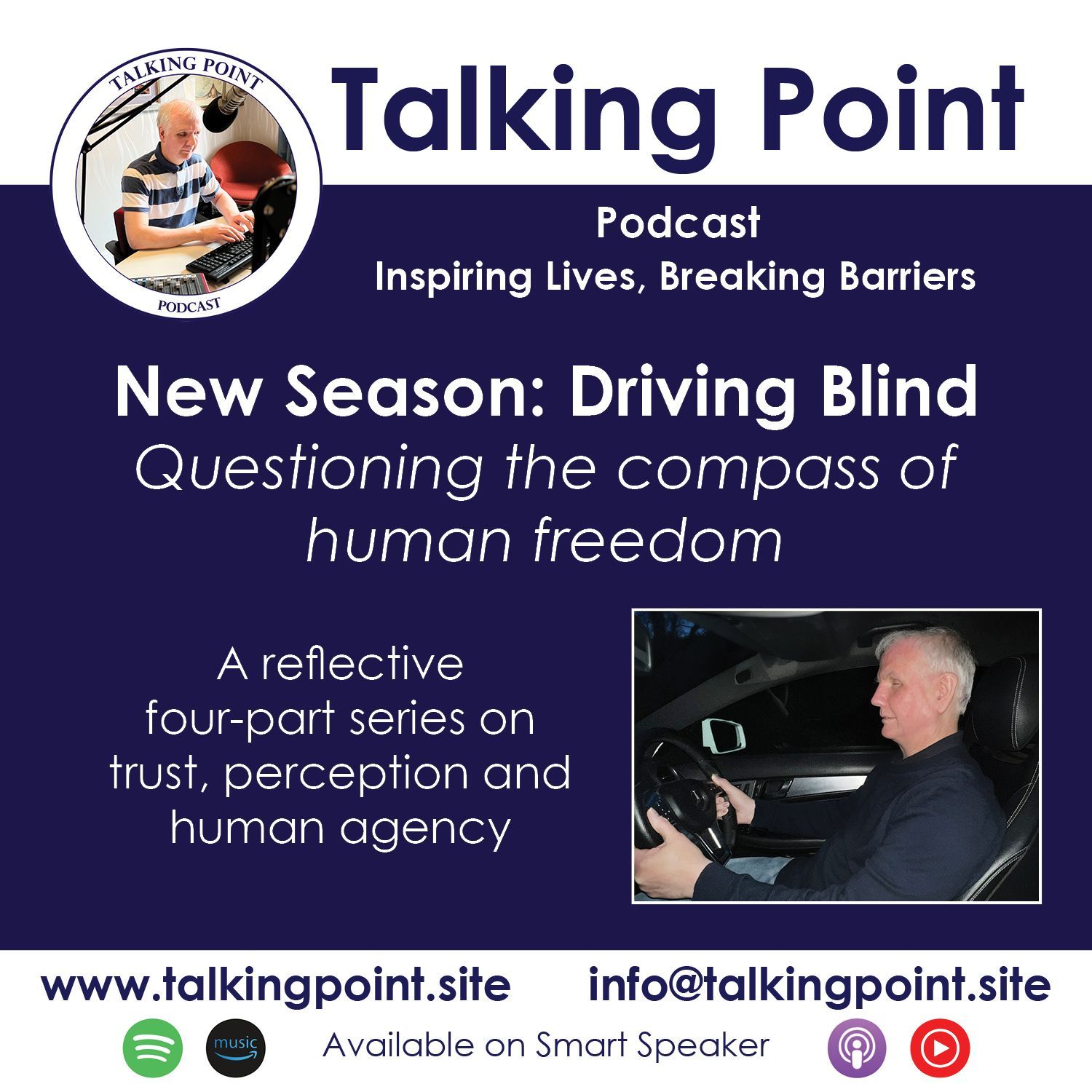
Video showing a profile image of a middle-aged man with short grey hair seated upright in the driver’s seat of a car at night. He is wearing a dark long-sleeved top and light-coloured trousers, with both hands resting on the steering wheel and facing forward. The interior of the vehicle, including the headrest and side window, is visible, while the exterior beyond the windows appears dark with faint distant lights.
Dedicated to my late cousin Paul.
Driving Blind
A reflective four-part series on trust, perception and human agency
What happens when the compass we’ve always trusted within ourselves begins to feel less certain?
Driving Blind is a four-part reflective podcast series exploring trust, perception and human agency in a world where direction is no longer taken for granted.
Beginning with a recurring dream of sitting behind the wheel on an open night road, the series unfolds into a wider meditation on memory, identity and influence. From childhood fascination with cars and learning to navigate life with sight loss, to the subtle ways technology now reshapes our sense of control, Driving Blind asks not simply how we travel, but how we understand freedom itself.
As the boundaries between instinct and automation, judgement and assistance, independence and interdependence continue to shift, the question becomes less about machinery, and more about meaning.
Is giving up control always a loss?
Or can it reveal something deeper about trust, perception and the way we shape our own direction?
Through personal reflection and immersive sound design, Driving Blind invites you to pause, to listen, and to reconsider what it truly means to navigate the world - and who, or what, we allow to steer.
Episodes in this series
The remaining episodes in the Driving Blind series will be released shortly, and will include:
Episode 1: Shedding the Light
Exploring the meaning of a recurring dream and the psychological and philosophical questions it quietly reveals about agency, memory and belief.
Episode 2: Seeing Beyond Sight
Examining perception itself: how we interpret reality, how assumptions shape what we think we see, and whether the compass we trust is as reliable as we believe.
Episode 3: Echoes That Shape Us
Exploring influence, legacy and the quiet ways other people shape our sense of possibility, agency and identity across time.
Episode 4: Taking the Wheel
Drawing the journey together by asking what it means to exercise human agency in a world increasingly shaped by intelligent systems and autonomous technologies.
Show Notes
Key Themes Explored
Narrative Identity Theory
Branch: Personality psychology / developmental psychology
Psychologist Dan McAdams argues that we construct identity through internalised and evolving life stories. We don’t just remember events - we interpret them symbolically and integrate them into who we believe ourselves to be.
Learn more: The power of personality | BPS
Self-Determination Theory
Branch: Motivational psychology
Developed by Deci and Ryan, this theory argues that autonomy is one of three basic psychological needs (alongside competence and relatedness). Even when external constraints exist, the internal experience of autonomy remains central to wellbeing.
Learn more: Harnessing your motivational superpowers | BPS
Cognitive Neuroscience of Simulation
Branch: Cognitive neuroscience / memory research
There’s strong research suggesting that the brain uses simulation to rehearse possibilities and explore agency. Dreams are increasingly understood as simulations - not predictions, but rehearsals. The brain activates many of the same networks in dreams as in waking imagination and future planning.
This includes:
- Default Mode Network activity
- Mental time travel
- Episodic future thinking
In short: the brain practices identity.
Learn more: The cognitive neuroscience of memory representations
Embodied Cognition
Branch: Cognitive science
Driving in my dream may function as an embodied metaphor. Embodied cognition suggests that abstract ideas like 'control' are grounded in physical experiences like steering, moving forward, balancing. My mind uses the physical schema of driving to explore abstract agency. That is not poetic - that is cognitive science.
Learn more: The psychology of scientific thought and behaviour | BPS
Additional Media
Subscribe to Talking Point
Listen to Talking Point on your smart speaker, phone, or favourite podcast app.
Rate this Podcast!
In terms of production quality and content, how would you rate my podcast?
Voting is anonymous and your personal data like name/email is not collected.
Attention screen reader users: Press space on the first value to activate full navigation. Use the tab key to navigate the questionnaire from there, using the space bar to select options.
In terms of production quality and content, how would you rate my podcast?
Comments Welcome!
To leave a general comment, feedback about a post, or even recommendations for a topic to cover, please just fill out this form. For those who would prefer to send their comment in using audio, there is the additional option to upload an audio file.
Contact Us
In line with GDPR, only complete this form if you are happy for me to use your answers for the purposes of processing of your request and in all
corresponding communications thereafter. Read my Privacy Policy for more information on how I manage your personal data. This contact form is also protected by reCAPTCHA, a Google system. Google's Privacy Policy and Terms of Service apply and are available to read when using the reCAPTCHA tool.